‏إظهار الرسائل ذات التسميات 2012. إظهار كافة الرسائل

الأربعاء، 4 أبريل 2012

World’s Largest and Most Expensive Yachts


Photo by autumn_leaf

Yachts are so beautiful and charming. They seem to fly over the waves inspiring a magnificent feeling of freedom. But having even a small yacht is not a cheap pleasure, not to mention the world’s biggest and most expensive yachts. I wish I could spend at least a day on one of these amazing mega-yachts, as I’m sure that would be unbelievable!
Dubai

Dubai is the current name of the second biggest yacht in the world. It is owned by Sheikh Mohammed bin Rashid Al Maktoum (the ruler of the Emirate of Dubai). It has a length of 162 m. It goes right after the Eclipse yacht (which is the largest one is 170 meters long). The construction process lasted over 10 years. The yacht was built by German construction company Blohm & Voss, and was completed by Lürssen Company. The Dubai is distinguished by its exclusive and graceful interior design created by French product designer Philippe Starck. Its huge lounge (which is able to host 80 people) is styled with mosaic floors and palm-like columns resembling an oasis in the desert. There is a gorgeous pool on the main deck with a waterfall running out to the down-level decks. The Dubai has 5 VIP apartments and 6 guest cabins; there is a helicopter pad, submarine, SPA-salon, and modern gym. The yacht is valued at$300 million USD.

Photo by strizale


Photo by saraab™

Photo by s_zeimke
Al Said

Al Said is a luxury yacht owned by Sultan Qaboos of Oman. This is currently the third largest yacht in the world with a length of 155 m. The yacht was built by one of the largest and most successful German shipbuilding companies, Lürssen Werft. The Al Said was ordered by the Oman royal family in 2006. It was launched in 2007 under code name Sunflower and then was renamed to “Al Said” after being purchased by Sultan Qaboos bin Said. The perfect interior design was created by Redman Whiteley Dixon Company. There is a luxurious concert hall which seats 70 visitors.

Photo from Wikipedia


Photo by Bilal /\/\iRza
Prince Abdulaziz

Prince Abdulaziz is considered the fourth largest motor yacht in the world with its length of 147 meters. It is owned by the Saudi Royal family for the past 26 years. The yacht was designed in 1984 by Maierform and built by Helsingør Værft in Denmark. For more than 20 years it was known as the world’s largest motor yacht. The Prince Abdulaziz is a classic example of eighties vessels. The helicopter pad is one of its important virtues; nowadays it is essential to modern motor yachts. The yacht was renovated in 2007 and became famous because of its speed of 22+ knots.

Photo from Wikipedia

Photo by thatgirl
Rising Sun

Rising Sun is the world’s sixth largest motor yacht after Al Salamah and Prince Abdulaziz. Its length is 138 meters. It is co-owned by Larry Ellison (CEO of Oracle Corporation) and David Geffen (American film producer). The Rising Sun yacht was built in 2004 by Lürssen Werft. The development expenses are estimated at $377 million USD. The yacht is equipped with jacuzzi bathrooms, gym & spa salons, a huge wine cellar, private cinema with a giant plasma screen, and a basketball court on the main deck which serves as a helicopter pad. Among its multiple advantages there is a major limitation – an inability to tie up at small ports and exotic islands.

Photo by Daisuke

Photo by Daisuke

Photo by PlanetStar 
Savarona

Savarona takes the seventh place in the world’s largest yachts rate. The luxury motor yacht is 136 meters in length. It was the largest motor yacht when it launched in 1931. Also, it was the first custom-made vessel built by German’s Blohm & Voss with an original cost of $4 million USD (much more by today’s standards). The Savarona was originally ordered by Emily Roebling Cadwalader, who owned it for a couple of years and then sold it to Kemal Ataturk, the Turkish President. Since 1980 the Savarona has been leased by Turkish businessman Kharaman Sadikoglu and treated as a charter luxury business yacht. The Savarona was completely rebuilt in 1999 and modern diesel engines were installed.

Photo by The Elder Dan

Photo by twiga269

Photo by steve.wilde 
Al Mirqab

Al Mirqab is the eighth largest yacht in the world, owned by Hamad bin Jassim bin Jaber Al Thani, Qatar’s Prime Minister. The yacht of 133 meters in length was built by Germany’s Kusch Yachts in 2004 and launched in 2008. In 2008, according to Forbes Magazine the Al Mirqab was called as the second most beautiful yacht in the world. The Al Mirqab is one of the most interesting luxury yachts; it has everything one can imagine on board – a helicopter pad, two jacuzzis, a cinema, water jets, bars, and a small fast boat.

Photo by twiga269

Photo by ehpien

Photo by epo:redia
Octopus

Octopus is the ninth largest (126 meters long) super-yacht in the world. It was custom built in 2003 for Paul Allen (co-owner of Microsoft Corporation) by Germany’s Lürssen Werft. The Octopus has been priced at around $170 million USD. The vessel’s hull is made of ice-resistant steel material. The excellent interior design was created by Jonathan Quinn Bennett and is famous for the cinema, audio recording studio, submarine, and pleasure boats. The Octopus has another special appeal – its transparent floor from which the mysterious underwater world can be observed.

Photo from Wikipedia

Photo by Daisuke Ido

Photo by ethan21

Photo by 1000zen
HMY Britannia

Her Majesty’s Yacht Britannia is the former Royal Yacht of the British Royal Family. With a length of 126 meters it is one of the largest yachts in the world. Due to its age (57 years by now) the royal vessel was decommissioned in 1997 and is currently moored as an exhibition ship at Leith, Edinburg, Scotland. During its history the Britannia transported a number of famous people such as U.S. Presidents Dwight Eisenhower, Gerald Ford, and Ronald Reagan; Charles and Diana, Prince and Princess of Wales who spent their honeymoon cruise aboard it in 1981, and many others.


Photo by stusmith_uk

Photo by Pauky 
Alexander

Alexander is known as the world’s 11th largest yacht after 8th Wonder yacht. Its length is 122 meters, with a capacity to hold 82 passengers. It was built in 1965 by Lubecker Flender for the Latsis Family. Currently the vessel is treated as a charter luxury yacht for the world’s famous celebrities and costs around $100,000 daily. The Alexander is distinguished by its old-style design and luxury modern equipment. There is everything one can dream of being on a board: two jacuzzis, meeting and conference halls, a private cinema, restaurant, pools and sunbathing places, a fast boat to enjoy the sea and, of course, a helicopter pad.

Photo by twiga269 

Photo by twiga269
“A” (Project Sigma)

“A” (Project Sigma) takes the 12th place in the worlds’ largest super-yachts with a length of 119 meters. The yacht was especially built for Belorussian business man Andrey Melnichenko in the summer of 2008 by the Blohm & Voss Shipbuilding Company. The Project Sigma yacht has an exclusive modern design proposed by reknowned French designer Philippe Starck. It is notable for its futuristic look with an axe bow and a small, tall superstructure at the aft end of the yacht. Among one of the largest luxury yachts, the “A” Project Sigma is found to be one of the ugliest ones as well.

Photo by afloden

Photo by twiga269


Read more »

Top 10 Richest Women In the World

Today we’re going to talk about the 10 richest women in the world. Most of these women inherited their fortunes rather than building them, but we have to give them credit for saving their fortunes, controlling businesses, and for making those fortunes grow. I’m not sure what would I do if I had even $100,000 in my bank account, nonetheless millions or billions. Would I feel happy or lost? Would I know what to do and who to trust? Money makes life easier but big money might make it much harder.
Instead of using photos of the ladies (and since all of those are copyrighted) we decided to use the logos of the companies they own and they make a much bigger impression than just a simple photo with a human being.

No.1 Christy Walton

Fortune: $22.5 billion
Walmart. U.S.

Christy Ruth Walton was the wife of late John T. Walton, one of the sons of Sam Walton who founded the Wal-Mart Stores company in 1962 — the biggest network of discount department stores in the U.S. and the world’s largest public corporation by revenue. After the death of her husband in 2005, Christy inherited his fortune of $15.7 billion. Wal-Mart is still the world’s largest retailer. The network includes more than 5,100 stores serving 138 million customers per week with sales around $285 billion. Christy is 50 now and has one son, Lukas.


No.2 Alice Walton

Fortune: $20.6 billion
Walmart. U.S.

Alice Louise Walton is the daughter of Sam Walton. Just like Christy Walton, she inherited her Wal-mart fortune. Alice is 60 and she’s 2 times divorced. Alice funded the $100 million airport in Bentonville in 1990 and was involved in the Crystal Bridges Museum of American Art development. Being an avid horse-lover, Ms Walton currently lives in Mineral Wells, Texas on The Rocking W Ranch.

No.3 Liliane Bettencourt

Fortune: $20 billion
L’Oreal. France

88 year old Liliane Bettencourt is an amazing French businesswoman. She is the principal shareholder of L’Oréal and the wealthiest woman in Europe. Liliane is the only child of Eugène Schuellerm, who was the founder of L’Oréal and she inherited her L’Oréal fortune from her farther in 1957. Liliane is married to a French politician, André Bettencourt, and they have one daughter Françoise. In December 2009 Françoise asked a French court to place her mother “under juridical supervision to stop her handing away her money” saying that her mother is no longer in her right mind for giving their money away (around one billion euro) and gifts to 62-year-old photographer François-Marie Banier over a several-year period. Now mother and daughter are estranged.


No.4 Birgit Rausing

Fortune: $13 billion
Packaging. Sweden

undefinedBirgit Rausing is a Swedish art historian and philanthropist. She inherited her billions after the death of her husband Gad Rausing in 2000. In 1944 her father-in-law founded Tetra Pak which revolutionized the packaging of liquids (juices, milk, etc.), so Birgit inherited the packaging giant Tetra Laval. Birgit lives quietly in Switzerland. She’s 86 by now and has 3 children.

No.5 Savitri Jindal

Fortune: $12.2 billion
Steel and power. India

Savitri Jindal is India’s richest woman, the world’s 44th richest person, and the non-executive chairperson of Jindal Steel- a steel and power conglomerate. She inherited the company and its billions in 2005 after her husband died in a helicopter crash. She’s 60 and has 9 children, Savitri is also a member of the Indian National Congress.


No.6 Abigail Johnson

Fortune: $11.5 billion
Fidelity. U.S.

Abigail Pierrepont is an American businesswoman and the President of Fidelity Investments Personal and Workplace Investing, founded by her farther. She joined the company when she was 25, having graduated from Harvard Business School. Abigail is happily married and has 2 children. She’s 48 now and believed to be her father’s chosen successor. She is number 48 in the list of the world’s billionaires.


No.7 Susanne Klatten

Fortune: $11.1 billion
BMW. Germany

Susanne Klatten is the richest woman in Germany and the 35th richest person in the world. On her father’s death, she inherited his 50.1% stake in pharmaceutical and chemicals manufacturer Altana. She sits on Altana’s supervisory board and helped transform it into a world-class corporation. Her father also left her a 12.50% stake in BMW, a company which he rescued from bankruptcy decades ago. Susanna is married and has 3 children, plays golf, and successfully invests her money.


N0.8 Iris Fontbona & Family

Fortune: $ 11 billion
Copper. Chile

There’s very little information about Iris available online. She has no page in Wikipedia, her age is unknown, and there are no photos. She was the second wife of Chilean billionaire Andronico Luksic (who was the richest person in Chile, the fourth in Latin America, and the 132nd in the world) who died from cancer in 2005. Iris and her family control one of the world’s largest copper mines, Antofagasta, with her son Jean Paul serving as chairman. Company shares have jumped 80% in a year, and the fortune amassed by Andronico was $4.2 billion.


N0.9 Jacqueline Mars

Fortune: $ 11 billion
Candy. U.S.


Jacqueline Mars is the daughter of Forrest Edward Mars, Sr. and granddaughter of Frank C. Mars — founders of the giant American candy company Mars, Incorporated. She’s a divorced woman of 70 with 3 children. Jacqueline inherited the company in 1999, and it’s constantly growing.


No.10 Anne Cox Chambers

Fortune: $10 billion
Cable and media. U.S.

Anne Cox Chambers is a media proprietor — a primary owner of Cox Enterprises, a privately held media empire that includes newspapers, television, radio, cable television, and other businesses. Anne has had a bright eventful life so far. She was an ambassador to Belgium from 1977 to 1981 and a director of the board of the Coca-Cola Company during the 1980s. She was also the first woman in Atlanta appointed to the board of the city’s chamber of commerce. Anne is a generous supporter of a wide range of cultural and educational charities. She’s 2 times divorced and has 3 children.

Read more »

World’s Worst Airports

What is the biggest frustration when it comes to traveling? “Everything was wonderful, except the delays, extra airline fees, and the airport!”
Airport
You’ve heard those sentiments from travelers, and likely spoken the very words yourself. To truly enjoy your travel, it’s best to be informed, prepared, and well-equipped.

There are things you can do to increase you rate for success. Know which amenities are available at the airports you will be arriving and departing from. Pack a nutritious snack in your carryon.
Wear comfortable clothes and shoes. And bring something for entertainment; a deck of cards, iPod, laptop, or a good book. If you can, avoid troublesome airports. This list of World’s Worst Airports is based on the lack of service, safety, comfort, and/or cleanliness.

Paris-Charles de Gaulle Airport (CDG) – World’s Worst!

CDG – aerial view

“I’m a French traveler and from what I saw abroad, CDG airport is the worst one I have ever been in.

I am fluent in French but still it is hard for me to find accurate information from the employees.” – Kimchietrip, sleepinginairports.com
“[Paris CDG has] the charm of a WW II concrete bunker and the rudest personnel in the world…” – IrmainNewberin, sleepinginairports.com
CDG has done much to improve their reputation (having been voted World’s Worst Airport several times). A few major problems still exist. There are many permanent residents at CDG. The homeless are mostly harmless, but an occasional drunken reveler is enough to upset travelers.
It has been reported that terminal one is now closed to the public at night. Admittance is only allowed with a flight ticket and valid ID. Terminals 2b and 3 are shockingly rough. Not what you expect from a world class city. Explore the terminals before setting up camp if you must sleep here. Sleep near travelers, not homeless.

Runners Up

BVA – Terminal 3 Beauvais-Tillé Airport (BVA) – B

Beauvais closes between 11pm and 6am. You will be kicked out at night.

There are no services, the terminal is a tent, and seating is limited.

SVO – jaunted.com Sheremetyevo International Airport(SVO) –

Moscow’s airport is dirty chaotic and smoky.

Even after some updates and remodeling, nonsmokers report they just can’t handle the smoke.

LAX – mahalie via Flickr Los Angeles International Airport (LAX) –

California’s popular airport is busy and crowded with limited seating.
Travelers label personnel as rude. Poor signage and poor bathrooms are other frustrations.

“I have seen grown men in my company sit down and cry a little, when they were told they had to fly through LAX. I am still wondering after 18 years, why nothing changes for the better ever in LAX.” – IrmainNewberin sleepinginairports.com.
“It’s a shame that many visitors from the pacific flying into LAX get their first impression of America and Americans at this dump.” – DonP

MNL – TOC SME via photobucket Manila International Airport (MNL) –

Manila is the main international gateway for travelers to the Philippines. The older terminal is in rough shape.

There is no seating and getting through customs is a difficult ordeal.
Be prepared to ignore beggars or people asking for bribes. On the upside the newer terminal (3) is clean, spacious, and has internet.

LTN – airliners.net London Luton Airport (LTN) -

London Luton is cold, drafty, and noisy.

The noise is punctuated with annoying announcements. The limited seating is uncomfortable.

JFK – bing John F. Kennedy International Airport (JFK) –

Not your only choice in New York, JFK garners complaints of “hectic and noisy.”

Seating is limited. The layout is confusing and amenities close at night. On the plus, there is WiFi.
We can survive anything with an internet connection!

One Place you WON’T Mind Getting Stranded

SIN – poshposh.com Singapore Changi Airport (SIN) –

The IATA call letters don’t do SIN any justice. Singapore’s Changi Airport was voted the best place for unexpected stopovers.

Of the 1,000 International Airline Passengers Association members surveyed, 32% said this was by far the best airport for delayed passengers. The multiple options for entertainment, beautiful décor, and abundance of greenery make it easy to pass the time here.
SIN 750,000 square feet of space for shopping and eating. Extensive upgrades and brands like Prada, Gucci, Bulgari, and Hermes make this the place to shop. Two different lounges with 24-hour napping areas, showers and spa facilities, hotel and pool amenities are just the start of the amenities list.
Have you ever been to an airport with a Nature Trail? There are six open-air gardens, children’s play areas, and TV viewing lounges.
Since opening in 1981 SIN has been the benchmark for service excellence. Changi Airport has won over 340 awards from 1987 to 2009, including 27 ‘Best’ awards in 2009. Changi continues to update, expand, and provide a high level of customer service.
Share your travel horror story below.

Read more »

Sushi: From Japan to Your Table


Sushi is a very popular food these days, and many cities offer a wide variety of sushi restaurants to choose from. Still, this Japanese style cuisine is not as well known to Americans as, say, Mexican or Italian dishes are. Here are some fun and useful things to know about this food when you go to eat in your local Japanese restaurant.


Sushi being prepared. ©2003 David Monniaux & Mai-Linh Doan (Wikimedia Commons)
Sushi: From Fermented Fish to Raw Fish

“Sushi” originally meant fermented meat or fish. 2,000 years ago, the Japanese preserved fish by salting it and leaving it to ferment. Later they started to pack the fish with uncooked rice to speed the fermentation process. Over time, this raw, fermented style of fish and rice became specialty dishes in their own right.

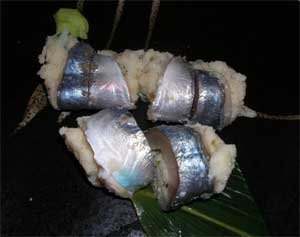
Nare sushi (fermented sushi). Credit: Sushi Encyclopedia

By the 1400s, tangy, fermented rice was a popular side dish. By the 1500s, Japanese cooks were adding vinegar to speed fermentation and artificially create the tangy taste. This also made fermented sushi less pungent. New kinds of sushi began to evolve using only cooked rice and vinegar and less-fermented fish. These various styles of sushi (such as Oshi, chirashi, and nuku) are still popular in Japan.

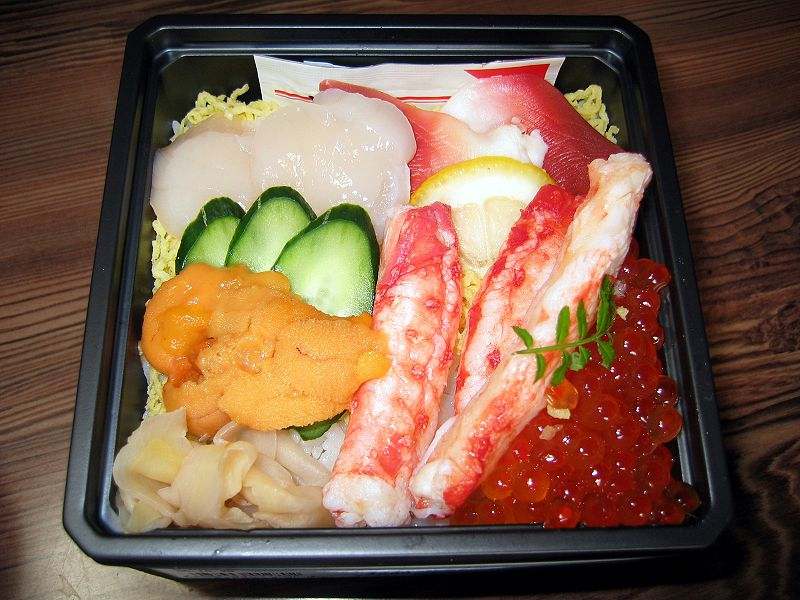
Chirashi sushi in Hokkai-style bento box. Credit: © 2006 rhosoi (Flickr)


By the 1800s, street vendors made “fast food” out of raw fish and sushi rice in what became known as Edo style sushi, named for the capital city. When Japanese businesses began expanding in the U.S. in the late 1970s, more sushi restaurants opened to serve food familiar from home.
The California Roll Revolution

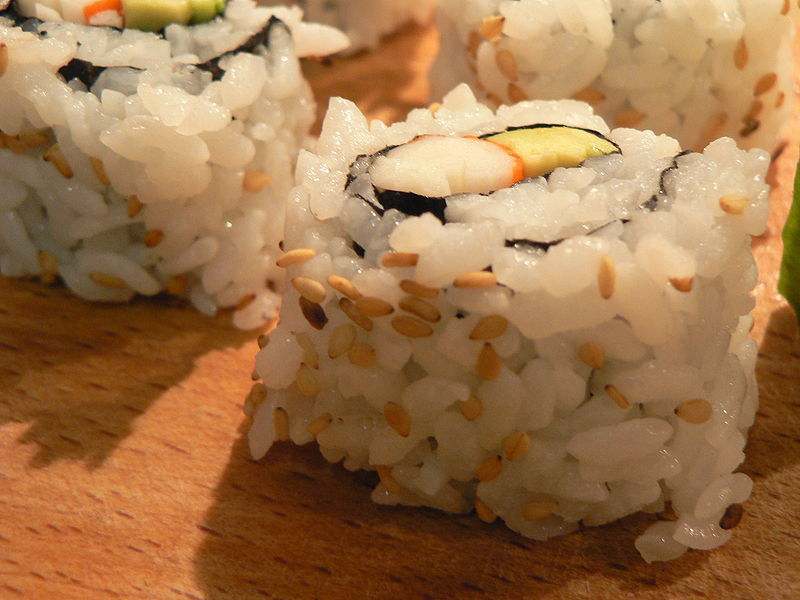
Americans weren’t so thrilled with the idea of eating raw fish until the California roll was invented. This combo of avocado and cooked crab was the perfect introduction to sushi for North Americans. Its success launched an era of experimentation and creation of new types of sushi. Today’s sushi is a fusion cuisine blending Japanese foods with ingredients an American palate enjoys.

California Roll. Credit: © 2008 Alessandro Scotti (Wikimedia Commons)
Eating Sushi

Sushi comes in many varieties but only a few basic styles. Here are the dinner table classics.

Nigiri sushi is the original street food from Edo. This oblong of vinegar rice is topped with the main ingredient (not always raw fish).

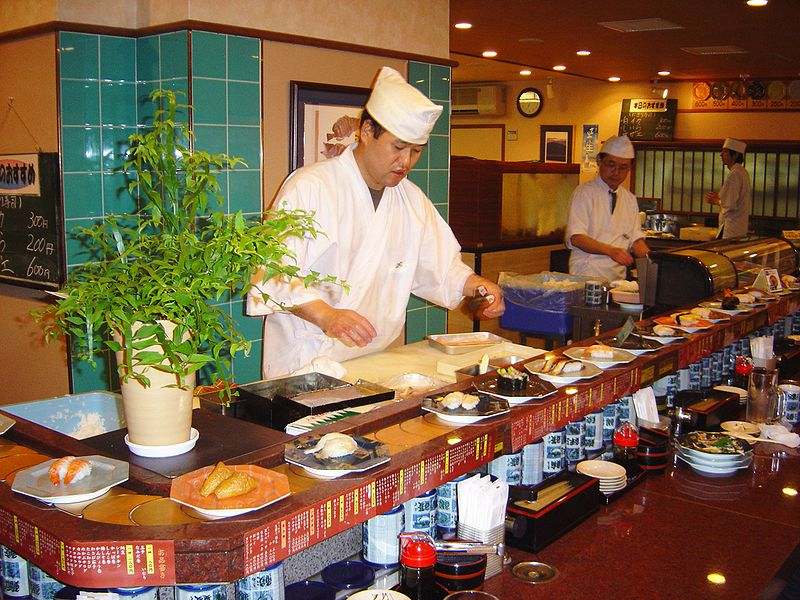
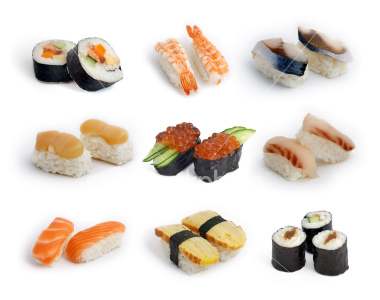
Sushi from a picture menu. Everything not rolled is nigiri. Credit: Wikimedia Commons


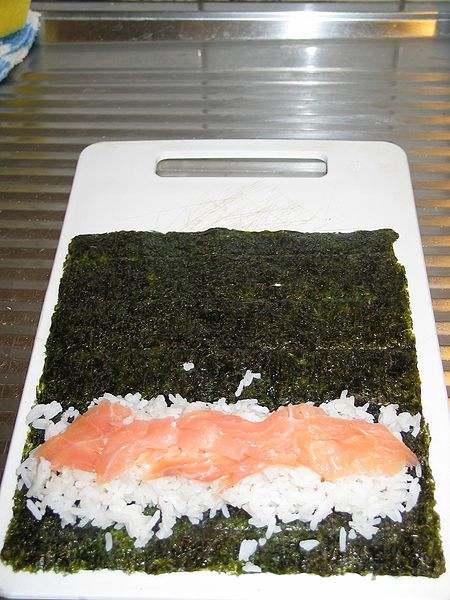
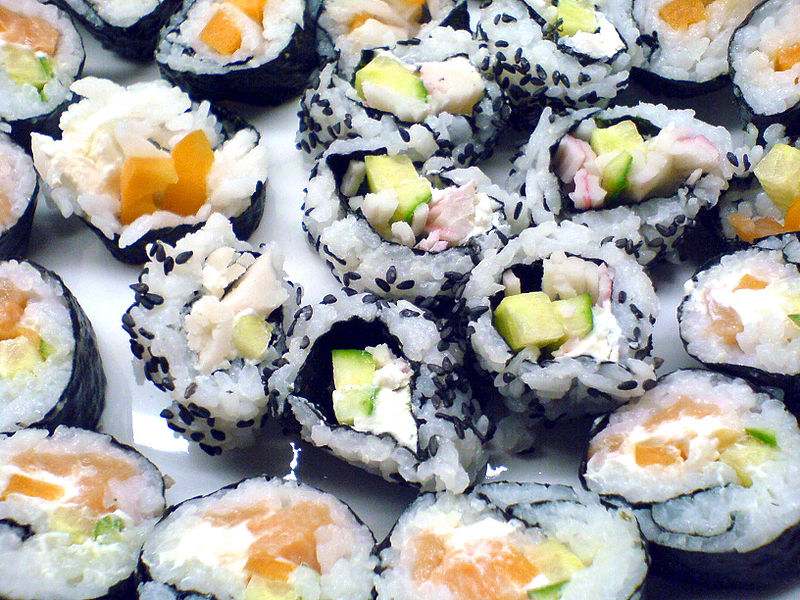
Maki is the name for a sushi roll. A piece of nori (dried seaweed) is covered with sushi rice and other ingredients, rolled shut, and sliced into rounds for serving.

Preparing maki sushi. Credit: Ciell at nl.wkikibooks


Rolling maki. Credit: © 2008 cyclonebill (Flickr)


Maki sliced and served. Credit: © 2008 cyclonebill (Flickr)

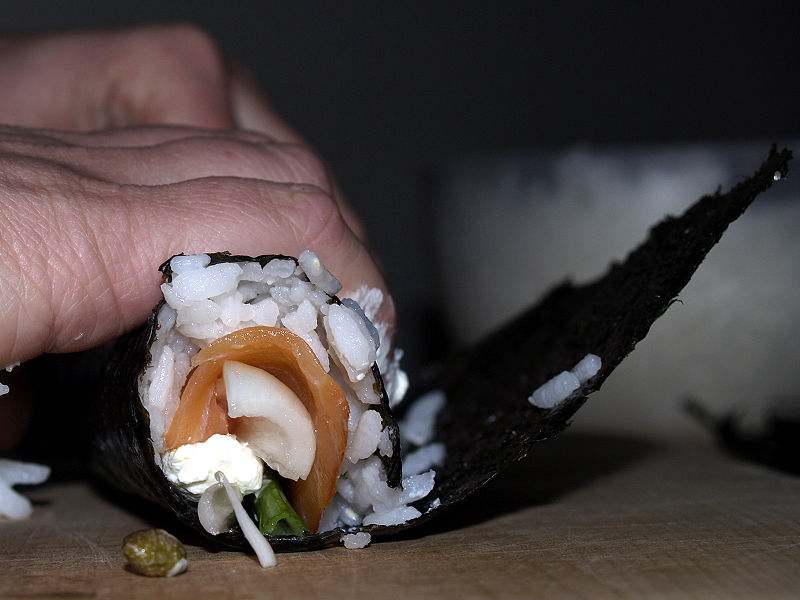
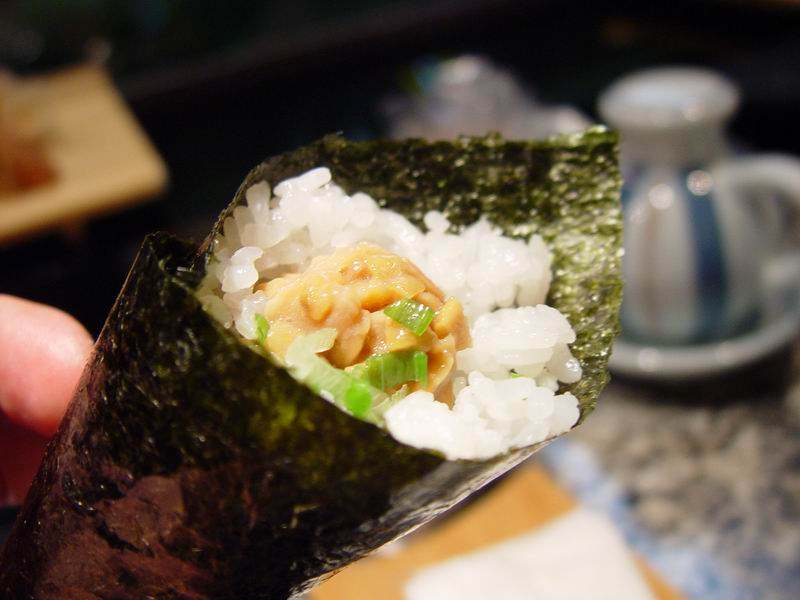
A hand-roll, called temakizushi, is maki rolled up into a loose cone with the ingredients inside. It is held by hand and eaten that way.

Sushi handroll (temakizushi). Credit: © 2004 nattokun (Wikimedia Commons)

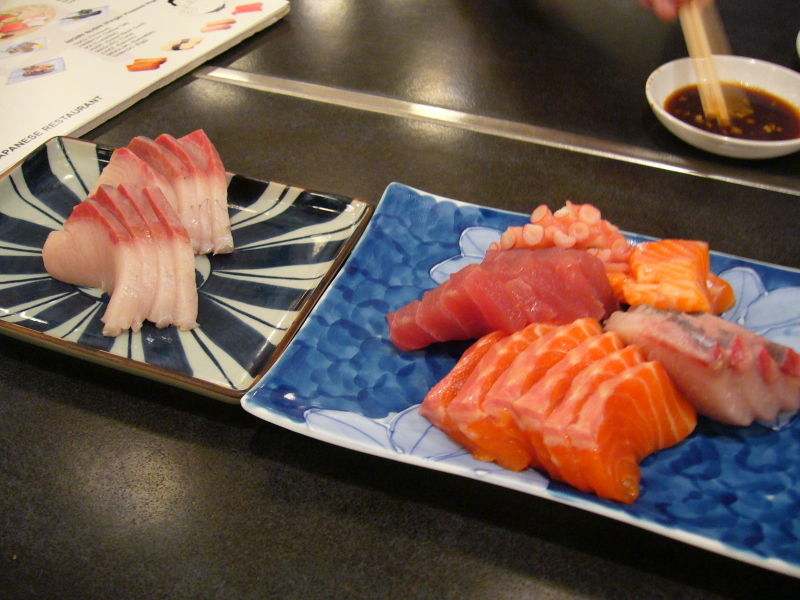
Sashimi is a word meaning sliced meat or fish. Sliced raw fish cut in the sashimi manner is often served in sushi restaurants, where diners may want just plain fish to eat with rice or condiments. Sashimi is not sushi, for it does not come bundled with vinegar rice as sushi does, but it is almost always available where sushi is.

Sashimi. Credit: © 2009 Chensiyuan (Wikimedia Commons)

Don’t like raw fish? No worries: there are plenty of cooked ingredients on the menu as well. Shrimp, grilled eel, and egg custard are just a few of the common ones, and many rolls have all-vegetable or veggie-and-cooked-fish ingredients. Ask your waitperson for suggestions if you’re in doubt.

Sushi and maki feast. ©2004 Tom Harpel (Flickr)

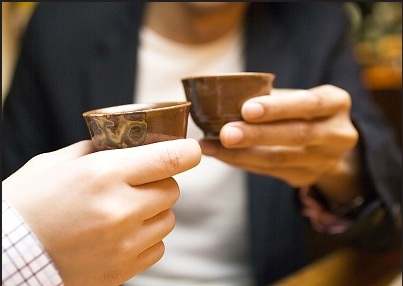
It’s acceptable to eat sushi with your fingers, if chopsticks are not cutting it. Soy sauce is poured into the flat bowls for dipping your food; try mixing a little wasabi (the green horseradish) in for a little extra zing. And if you have more than a little zing, you might discover the pleasures of hot sake to chase it all down with. Kampai! (Cheers!)


Finding a Sushi Restaurant

For some good recommendations on sushi restaurants near you, check out Yelp, or Citysearch if you are in a larger urban area.

Read more »